Try asking an AI assistant this question:
“What is the most optimal way to repay my mortgage?”
You’ll likely get a confident answer. It will sound reasonable. It might even look well structured.
But there’s a good chance it will miss something important. Why? Because the Swiss personal finance system is unusually complex.
Decisions about mortgages, pension pillars, taxes, and investment strategies often interact in ways that are difficult to evaluate without detailed modelling.
Maybe it ignores withdrawal tax differences.
Maybe it assumes rules that apply in the US or EU but not in Switzerland.
This isn’t a flaw, but a byproduct of how general AI is built. Tools like ChatGPT are incredible generalists, trained to prioritize global patterns over local precision. However, while they excel at being a ‘jack-of-all-trades’, Swiss personal finance, like any other deep knowledge subject, requires mastering specifics. In a landscape where local tax laws and pension rules collide, a general answer isn’t enough, you need an accurate one.
That is exactly the type of problem AIctuary was build to address.
A specialist system such as AIctuary aims to focus on those Swiss-specific rules and actuarial interpretation rather than treating them as generic finance questions.
The goal is not to replace general AI tools, but to complement them with something different:
a specialised assistant built for one complex financial environment.
Why Swiss Finance Is Hard for General AI
Most AI tools today are simply wrappers around a generic language model.
That approach works well for writing emails or explaining concepts. But it’s less reliable when questions involve complex financial systems.
When I make financial decisions in Switzerland I take into consideration several systems interacting at once: all pillars of the pension system, income tax, capital tax and wealth tax, differences in taxes between Kanton and Gemeinde, Swiss mortgage rules, opportunity cost, current market reality and many more. The list is long
A general AI might explain each of these separately. But it often struggles when the rules interact.
Research in AI shows a consistent pattern: large language models perform very well on simple financial tasks, but their performance declines as reasoning becomes more complex and multi-step.
| Type of financial task | Typical accuracy of general AI |
| Basic financial knowledge and concept explanation | ~85–95% |
| Financial information extraction from text | ~70–85% |
| Financial numerical reasoning and calculations | ~55–75% |
| Multi-step financial reasoning and decision scenarios | ~40–60% |
Sources: FinMaster: A Holistic Benchmark for Mastering Full-Pipeline Financial Workflows with LLMs and The FinBen: An Holistic Financial Benchmark for Large Language Models
The pattern is simple: the more financial reasoning involved, the harder it gets.
ChatGPT and Gemini can do a great job explaining calculations but they aren’t calculators. They function by predicting the next most likely ‘token’ rather than executing raw logic, they can stumble on complex arithmetic. Hence, if you need precise numerical results, tools like Excel, Python, or actuarial software are still the right choice.
From General AI to AIctuary
That gap is what led to the idea behind AIctuary.
The goal wasn’t to build a new AI from scratch, but to ground a system specifically in actuarial logic and Swiss financial rules. The key difference isn’t the underlying AI engine itself.
The difference is the specialized knowledge base, the structured ontology, and the vetted data it uses to find its answers.
The result? A general AI can describe what a mortgage is, but AIctuary can provide detailed guidance on specifics, such as how to optimize a 2nd pillar pension to repay that mortgage.
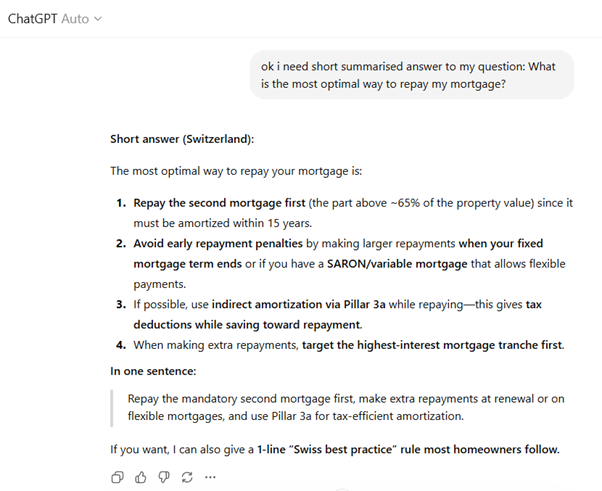
Let’s compare the answer AIctuary and General AI (in this example I used ChatGPT) gives to the question stated at the beginning: “What is the most optimal way to repay my mortgage?”
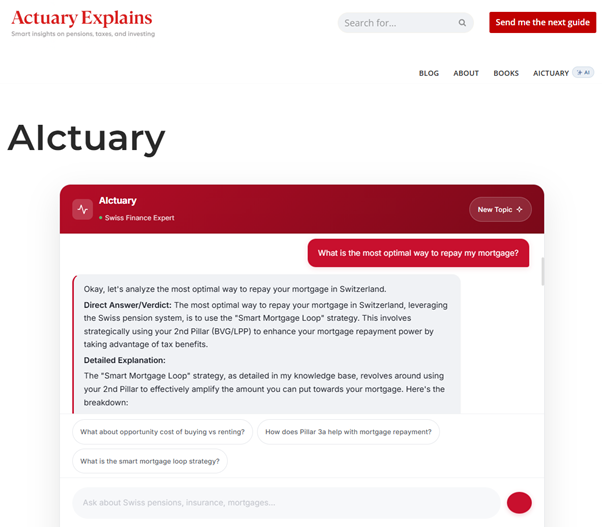
I asked the same question to ChatGPT and it suggested using Pillar 3a to repay the full mortgage. Thinking to leverage pension system is the right direction, however Pillar 3a has low annual cap. It completely missed much bigger opportunity of using Pillar 2.
The Real Value of AIctuary
If your software is an off-the-rack suit, it will never fit perfectly. Well unless you have a standard shape and size 38 always fits you.
AIctuary is more like a custom-tailored suit built around the Swiss financial system. So if your shape isn’t fully regular (or your financial question is specific) you may need that. Unless you’re fine to invest your money based on advice from General AI that’s 40-60% accurate.
The value isn’t really the AI model.
The value is the knowledge base baked into it.
Foundation of that knowledge are my articles and calculators including industry data, rules, and decision frameworks. This is what makes AIctuary useful.
Is AIctuary better at answering questions about the Swiss financial system than ChatGPT or Gemini?
I believe so.
Is AIctuary always right?
No, and I wouldn’t claim it is. But by implementing specialized guardrails and a Swiss-centric data layer, I’ve minimized the “hallucinations” common in broader AI. Plus, as the blog’s ecosystem of calculators and articles grows (knowledge base), so does the intelligence of the model.
A Simple Way to Test It
The best way to make the most of an AIctuary is not to prompt simple questions, but rather specifics you want to learn more about!
Instead try something real, like:
- How should I spread pillar 3a contributions across years?
- Is investing my bonus in ETF better than using it to buy in into my 2nd pillar?
These are exactly the kinds of questions where general AI tends to struggle.
And they’re exactly the kind of questions AIctuary was built to explore.
If you’re curious, try it with a scenario you’ve been thinking about.
You might be surprised how much better it feels when using a specialist instead of a generalist.
Curious how it handles your situation?
I don’t publish often. Only when I believe something is truly worth sharing. If you’d like the next guide when it’s ready, you’re welcome to join below:
Send me the next guide