Is the Swiss property market overvalued, or is it a fortress? Every year, the question of whether to buy or wait becomes more complicated, and the advice you receive is often biased by the current market’s 25-year long climb.
To provide an objective answer, I compare the risks of the early 1990s, the last time the Swiss property market collapsed, directly against the metrics of today’s market.
This comparison is not a forecast, but it is a baseline for risk. If you are debating whether to leverage your capital into a property purchase in 2026, the variables in this article are the most important data points you will analyze.
If you only want the 60-second answer, the table below is enough.
But if you’re considering committing making a six- or seven-figure decision, I’d encourage you to keep reading.
What happened to buyers who purchased at the peak of the last Swiss property bubble? How painful was the crash? How long did recovery take? And would they have been better off investing in Swiss equities instead?
The answers surprised me.
Could A Swiss Property Crash Happen Again?
Yes, but probably not in the exact 1991 form. A modern Swiss real-estate crash would likely require several shocks at once, because the system is better capitalised, deposit protection is stronger, and many households have fixed-rate loans. But the underlying vulnerability – very large mortgage debt against high property values, has not disappeared.
The 1990s crash happened partly because lending standards were loose. Today, 20% as the down payment is required and affordability must be demonstrated at a theoretical 5% interest rate even when actual rates are far lower. These rules exist precisely to prevent another 1990.
These affordability rules are one of the least understood parts of Swiss homeownership and often surprise first-time buyers. I explain the mechanics in detail in Rent vs Buy in Switzerland: Which Is Better?
But they do not eliminate the risk. They reduce it. A sharp and sustained rise in rates, combined with a demand shock, could still produce meaningful price corrections in overheated markets.
Table 1. Swiss Property Market 2026 vs The 1990s Crash: Key Risk Factors Compared
| Risk factor | Swiss property market in the early 1990s | Swiss property market in 2026 |
|---|---|---|
| Mortgage debt | Already very high; CHF 411.2bn total mortgage debt at 1990, estimated at 80–90% of GDP[1] | Bank mortgage lending around CHF 1.24tn in June 2025, and around 140% of GDP in 2024[2][3][4] |
| Borrower rate exposure | Variable rates were more common; 24% fixed-rate mortgages in 1994[2] | Fixed-rate mortgages are more common; around 75% fixed-rate mortgages in 2024, though refinancing risk remains[2] |
| Affordability tests | Lending standards were significantly looser. | Banks test affordability using theoretical rates at 5%, even when actual rates are lower[2][3] |
| Down payment requirements | Banks sometimes financed up to 100% of property values. | Minimum 20% equity is generally required[2][3] |
| Population growth | Weaker demographic support. Switzerland’s population grew by about 0.6% per year between 1990 and 2000[5] | Stronger demographic support. Population growth was around 0.8–1.0% per year between 2010 and 2024, largely driven by net immigration[5] |
| Employment situation | Recession and rising unemployment reduced housing demand. Unemployment rose from around 0.5% in 1990 to 5.2% in 1997[6] | Employment remains relatively strong. SECO reported unemployment averaging about 2.4% in 2024, with forecasts generally near 2.5–3.0%[6] |
| Property valuations | Swiss residential property prices roughly doubled between 1980 and 1990 before falling by about 25–30% nationally during the correction[2][7] | Residential property prices are near record highs. In Zurich and Geneva prices tripled between 2000 and 2025[5][7] |
| Investment-property risk | Investment and commercial real-estate lending expanded rapidly. Real-estate-related non-performing loans became a major banking problem[2] | FINMA continues to identify buy-to-let and income-producing real-estate lending as a key vulnerability[3] |
| Banking system resilience | The banking sector suffered heavy losses. More than 100 regional and cantonal banks required restructuring, mergers, or support[2] | Systemically important banks are subject to Basel III and Swiss too-big-to-fail rules. Capital ratios are materially higher than in the early 1990s[2][3] |
Sources
- Bank for International Settlements (BIS) – Long-Term Credit Statistics
- Swiss National Bank (SNB)
- FINMA – Swiss Financial Market Supervisory Authority
- OECD Statistics
- Swiss Federal Statistical Office (FSO)
- State Secretariat for Economic Affairs (SECO)
- UBS Swiss Real Estate Bubble Index and Historical Real Estate Research
Key Insight: Switzerland still has exceptionally high mortgage debt and elevated property prices, but today’s market benefits from stricter lending standards, higher bank capital requirements, fixed-rate mortgages and stronger demographic support than before the 1990s crash.
My Take
The Swiss property market is probably safer today than it was in 1990.
But safer does not mean risk-free.
A modern correction would likely require a combination of higher interest rates, rising unemployment, weaker immigration, stress in investment properties, and falling confidence.
In other words, the ingredients are different, but the recipe still exists.
Understanding whether those risks are worth taking depends heavily on the opportunity cost of your down payment, which I explored in ETF vs Swiss Property: The Opportunity Cost of Buying a Home.
Anatomy of a Bubble: What Caused The Swiss Property Crash Of The 1990s?
It was a property-credit-banking crisis that followed an 1980s boom, a sharp interest-rate tightening, a recession, weak real-estate lending, and severe losses at regional and cantonal banks.
In the late 1980s, the Swiss economy was booming. Personal incomes were rising, vacancy rates were low, and mortgages rates were low. After the 1987 stock-market crash, real estate became especially attractive. Pension money flowed in. Investors piled into rental properties. Banks were generous with credit, often lending up to 100% of the property value, usually with variable-rate mortgages and little pressure to amortise.
For a while, it worked. Prices rose quickly. Construction followed.
Then the environment changed.
By the end of the decade, inflation picked up and the Swiss National Bank tightened monetary policy. Mortgage rates rose, and because most loans were variable, households felt it immediately. At the same time, the economy slid into recession around 1991. Demand fell, but supply didn’t. Projects already under construction kept coming onto the market. Vacancy rates rose. Rents softened. Prices began to fall.
And they didn’t fall gently.
Between 1991 and 1996, apartment prices dropped by around 25% nationwide (Source: Swiss National Bank historical property data). In cities like Bern and Zurich, the decline was closer to 20%. This wasn’t a short correction, it was a multi-year downward trend.
The real damage, though, showed up in the banking system. High leverage meant falling prices quickly turned into negative equity. Smaller banks, heavily exposed to property, suffered large losses. Some defaulted. The collapse of Spar- und Leihkasse Thun in 1991 became a symbol of how quickly confidence can disappear when real estate turns. By some estimates, bank losses linked to the crash reached around 10% of GDP.
There was no quick fix. The bubble deflated the old-fashioned way: tighter credit, write-offs, bank consolidation, and a long period of caution. Property stopped feeling like a one-way bet. Lending standards hardened. The lesson stuck.
That episode still shapes Swiss housing policy today. It’s why banks insist on affordability tests, amortisation rules, and conservative valuations. It’s why the SNB watches real estate so closely.
Assuming you bought property in Zurich or Bern in 1991 (peak price) you saw it dropping 20% value and reaching bottom in year 2000. From there it took another 5 years for Zurich and another 7 years for Bern to get back to your purchase price. About 15 years of lost property appreciation.
Graph 1. Swiss Property Prices in Zurich and Bern (1985–2025): The 1990s Crash and Recovery
| Year | Zurich Region Price Index | Bern Region Price Index |
|---|---|---|
| 1985 | 91.6 | 87.8 |
| 1986 | 90.5 | 87.7 |
| 1987 | 95.0 | 90.9 |
| 1988 | 101.5 | 97.7 |
| 1989 | 114.6 | 107.9 |
| 1990 | 120.7 | 114.3 |
| 1991 | 124.8 | 118.9 |
| 1992 | 122.1 | 116.5 |
| 1993 | 120.1 | 114.6 |
| 1994 | 114.7 | 110.8 |
| 1995 | 110.3 | 108.3 |
| 1996 | 105.6 | 106.0 |
| 1997 | 102.5 | 101.8 |
| 1998 | 101.2 | 101.3 |
| 1999 | 100.8 | 100.5 |
| 2000 | 100.0 | 100.0 |
| 2001 | 102.2 | 101.4 |
| 2002 | 104.2 | 100.4 |
| 2003 | 109.0 | 100.7 |
| 2004 | 114.9 | 105.5 |
| 2005 | 120.4 | 108.8 |
| 2006 | 129.4 | 113.9 |
| 2007 | 138.2 | 120.6 |
| 2008 | 145.6 | 122.3 |
| 2009 | 150.9 | 125.5 |
| 2010 | 161.5 | 130.2 |
| 2011 | 176.4 | 138.3 |
| 2012 | 187.4 | 143.9 |
| 2013 | 195.4 | 149.1 |
| 2014 | 200.7 | 153.1 |
| 2015 | 205.5 | 158.0 |
| 2016 | 204.3 | 156.4 |
| 2017 | 208.7 | 156.5 |
| 2018 | 221.6 | 162.7 |
| 2019 | 229.5 | 166.4 |
| 2020 | 240.2 | 169.5 |
| 2021 | 258.7 | 180.1 |
| 2022 | 278.1 | 190.1 |
| 2023 | 286.4 | 193.8 |
| 2024 | 298.9 | 203.2 |
| 2025 | 313.1 | 210.1 |
Source: Raw index data from SNB, analysis by ActuaryExplains.ch
Of course if you look at the graph afterwards it looks like a small bump, however I’m sure it didn’t feel like that for anyone that needed to sell their house around year 2000.
For homeowners who already own Swiss property, there are also ways to improve mortgage efficiency through the pension system. I explain one such strategy in The Smart Mortgage Loop: Using Pillar 2 To Reduce Mortgage Debt.
The Math of Negative Equity: How Leverage Magnifies Losses In A Property Crash
Property prices back then were much lower so let’s say you buy a CHF 500’000 property in 1986 with CHF 100’000 down and a CHF 400’000 mortgage. By 1996, the property is worth CHF 350’000. Your equity – the CHF 100’000 you saved – is gone. Worse: you owe the bank CHF 400’000 on an asset worth CHF 350’000. That is negative equity of CHF 50’000.
Negative equity occurs when the market value of a real estate asset falls below the outstanding balance of the mortgage used to purchase it.
This is the darker side of leverage. The same mechanism that accelerates wealth creation during rising markets can amplify losses during downturns. I explored both sides of this equation in The Power of Leverage: How Homeowners Build Wealth Faster.
You are still paying mortgage interest, which peaked at around 7% in 1992. On CHF 400’000, that is CHF 28’000 per year – for a house worth less than you owe on it. Meanwhile, the ETF investor from Path A is watching Swiss equities compound through the golden decade of the 1990s.
Historically, periods of high rates have rewarded homeowners who entered downturns with lower debt levels. That’s one reason I’ve spent considerable time analysing mortgage repayment strategies, including my article on The Smart Mortgage Loop.
So looking again at opportunity cost – it’s not just the loss itself, but the 12 to 15 years of compounding you missed while waiting to break even. This is the same framework I used in ETF vs Swiss Property: The Opportunity Cost of Buying a Home, where I compared the long-term wealth impact of investing versus buying.
What If You Never Had To Sell?
The 1990s crash was painful, but it affected homeowners differently.
The worst outcomes happened when people needed liquidity. Perhaps they lost a job, got divorced, moved abroad, or simply could no longer afford the mortgage after rates rose. Negative equity becomes a real problem only when you need to sell an asset that has fallen in value.
For families who bought a home to live in and could comfortably continue making the payments, the experience was very different.
Their property value still fell. On paper, they became poorer. Some even entered negative equity. But as long as they could keep making mortgage payments, nothing forced them to realise those losses.
Eventually, the market recovered.
This is one of the most important distinctions in property investing. Leverage becomes dangerous when falling prices coincide with a need for liquidity.
The biggest risk of leverage is not that prices fall.
The biggest risk is that prices fall at exactly the moment you need liquidity.
This is one reason I always encourage buyers to stress-test their finances before purchasing rather than relying on optimistic market assumptions. You can use my neutral buy vs rent calculator for that.
One way to improve resilience is to gradually reduce debt over time. For homeowners planning to stay long term, I explored an advanced Swiss pension strategy for mortgage reduction in The Smart Mortgage Loop.
Swiss Property vs equity ETF: A 40-Year Comparison Starting Before The Crash (1986–2026)
What if you are an investor that in 1986 was deciding whether to invest starting capital of CHF 100’000 into equity ETF or as downpayment for a property.
Path A – SPI investor: Invests CHF 100’000 in 1986 and reinvests all dividends. The SPI has delivered a total return CAGR of approximately 7.6% since 1986.
Graph 2. Swiss Performance Index (SPI) Total Returns (1987–2026)
| Year | SPI Total Return Index |
|---|---|
| 1987 | 769.40 |
| 1988 | 942.50 |
| 1989 | 1137.90 |
| 1990 | 908.30 |
| 1991 | 1052.80 |
| 1992 | 1238.57 |
| 1993 | 1867.84 |
| 1994 | 1725.53 |
| 1995 | 2123.43 |
| 1996 | 2511.88 |
| 1997 | 3898.15 |
| 1998 | 4497.12 |
| 1999 | 5022.86 |
| 2000 | 5621.13 |
| 2001 | 4382.94 |
| 2002 | 3245.50 |
| 2003 | 3961.58 |
| 2004 | 4234.56 |
| 2005 | 5742.41 |
| 2006 | 6929.18 |
| 2007 | 6925.44 |
| 2008 | 4567.57 |
| 2009 | 5626.40 |
| 2010 | 5790.62 |
| 2011 | 5343.52 |
| 2012 | 6290.52 |
| 2013 | 7838.00 |
| 2014 | 8857.03 |
| 2015 | 9093.97 |
| 2016 | 8965.70 |
| 2017 | 10751.51 |
| 2018 | 9830.06 |
| 2019 | 12837.50 |
| 2020 | 13327.88 |
| 2021 | 16444.52 |
| 2022 | 13734.86 |
| 2023 | 14571.23 |
| 2024 | 15472.33 |
| 2025 | 18219.49 |
| 2026 | 18551.09 |
Key insight: Despite the dot-com crash, the Global Financial Crisis and the COVID-19 market shock, the Swiss Performance Index (SPI) Total Return Index increased from 769 in 1987 to 18,551 in 2026, illustrating the long-term power of dividend reinvestment and compounding.
Source: SIX Swiss Exchange SPI Total Return Index data. Analysis by ActuaryExplains.ch.
A one-time CHF 100’000 investment in Swiss equities grew to approximately CHF 1’873’000.
No debt. Full liquidity. Equities also went through 3 major crashes since 1990 – the 2000 dotcom crash, the 2008 financial crisis and the 2020 pandemic all happened – and were absorbed by the compounding.
Path C – Property buyer: Same CHF 100’000 as a 20% down payment on a CHF 500’000 property in 1986. The crash hits. Recovery takes until the early 2000s. After that, the Swiss market enters a long upswing. Over the full 40 years, Swiss apartment prices averaged approximately 3% annual appreciation – reflecting the slow recovery years dragging down the otherwise strong post-2005 period.
Minus outstanding mortgage (for simplicity let’s assume we didn’t amortise anything and we still owe the bank full CHF 400’000): net equity of approximately CHF 1,231’000.
And that is before any cantonal property gains tax on exit, which can take another CHF 200’000 (calculated as roughly 20% of property gains)
Table 2: The 40-Year ETF vs Property comparison (1986–2026, CHF 100’000 Starting Capital)
| Metric | Path A: SPI Investor | Path B: Leveraged Property Investor |
|---|---|---|
| Starting capital | CHF 100’000 | CHF 100’000 down payment |
| Investment exposure | Swiss Performance Index (SPI) | Swiss residential property with mortgage leverage |
| Net annual growth rate | 7.6% CAGR | 3.0% property appreciation |
| Final asset value (2026) | CHF 1’873’000 | CHF 1’631’000 |
| Debt outstanding | CHF 0 | CHF 400’000 |
| Property gains tax | CHF 0 | CHF 200’000 |
| Terminal net worth | CHF 1’873’000 | CHF 1’031’000 |
| Peak drawdown | ~34% (2008) | ~30% (1990s crash) |
| Recovery period | ~5 years | ~15 years |
| Years of negative equity | 0 | ~7 years |
| Did leverage help? | Not applicable | No, not during the first 15 years |
The SPI investor ends up roughly CHF 840’000 ahead – despite the property buyer holding a higher gross asset.
The reason: leverage is a return accelerator, but only when the underlying asset is rising. From 1990 to 2003, Swiss property gave the leverage nothing to accelerate. The equity investor, by contrast, had uninterrupted compounding – through crashes that were steep but short compared to a 15-year property stagnation.
This analysis does not consider the costs of owning a property, nor does it account for the opportunity cost of choosing to invest in ETFs instead of buying a home. And, of course, you cannot live inside an ETF.
As we saw in my previous article, one of the largest costs in the rent-versus-buy decision is the rent you continue paying while remaining a tenant. If you would like to see a full opportunity cost analysis, including ownership costs, leverage, taxes, and long-term wealth accumulation, see: ETF vs Swiss Property: The Opportunity Cost of Buying a Home.
Should You Delay Buying Because Swiss Property Looks Overvalued?
I saved this one for last because it’s the most controversial.
Some people believe Swiss property prices are unsustainable. Their argument: price-to-income ratios in Zurich are at historic highs, low interest rates created artificial demand that will fade as rates normalise, remote work reduces the premium for urban locations, and immigration patterns could shift.
If you are trying to decide whether current valuations justify buying, I would also recommend reading Rent vs Buy in Switzerland: Which Is Better?, or running your own numbers in buy vs rent calculator.
If you believe Swiss property market is a bubble, buying now feels like buying at the top. And if you think you’re at the top, the instinctive reaction is to wait for a correction. That fear isn’t irrational, buying at the top should feel scary, for the right reasons.
History gives us plenty of examples. If you bought the S&P 500 at the start of 2000 and look only at prices (ignoring dividends), you ran straight into what’s now called the lost decade. From the end of 1999 to the end of 2009, price returns were flat to slightly negative, and even including dividends, total returns were very weak around –0.9% per year over the decade. In real, inflation-adjusted terms, investors didn’t meaningfully break even until the early 2010s.
Or take Japan. If you bought Japanese equities via the Nikkei 225 after its 1989 peak, you experienced something far more extreme. The index reached almost 39’000 in late 1989 and then didn’t sustainably surpass that level for about 34 years, only doing so in early 2024. Those years are now known, quite accurately, as Japan’s lost decades one of the longest market stagnations in modern financial history.
The counter-argument: people have been calling Swiss property overvalued since 2010. Every year, they’ve been wrong. Prices have continued climbing. The structural factors: land scarcity, zoning restrictions, safe-haven status, stable population growth, haven’t changed. Until they do, expecting a major correction is a bet against history.
Timing the market is a mug’s game. What I am certain of is this: if you’re buying to live, not speculate, short-term price movements matter less than long-term fundamentals. If you’re buying for yourself, a 5% price drop in year 2 is irrelevant. You’ll ride it out and come out ahead.
In practice, the most important decision is often not whether property is overvalued, but whether the property fits your financial plan, mortgage structure, and long-term goals. That’s exactly the framework I use in Rent vs Buy in Switzerland: Which Is Better? You can model your own situation using my Swiss Buy vs Rent Calculator, which compares ownership costs, rent, taxes, opportunity cost, and long-term wealth accumulation.
One Article Is Not Enough
Whether Swiss property is overvalued is only one piece of the decision.
The bigger questions are:
Can you comfortably afford the property?
What is the opportunity cost of your down payment?
How much risk are you taking through leverage?
And what happens after you become a homeowner?
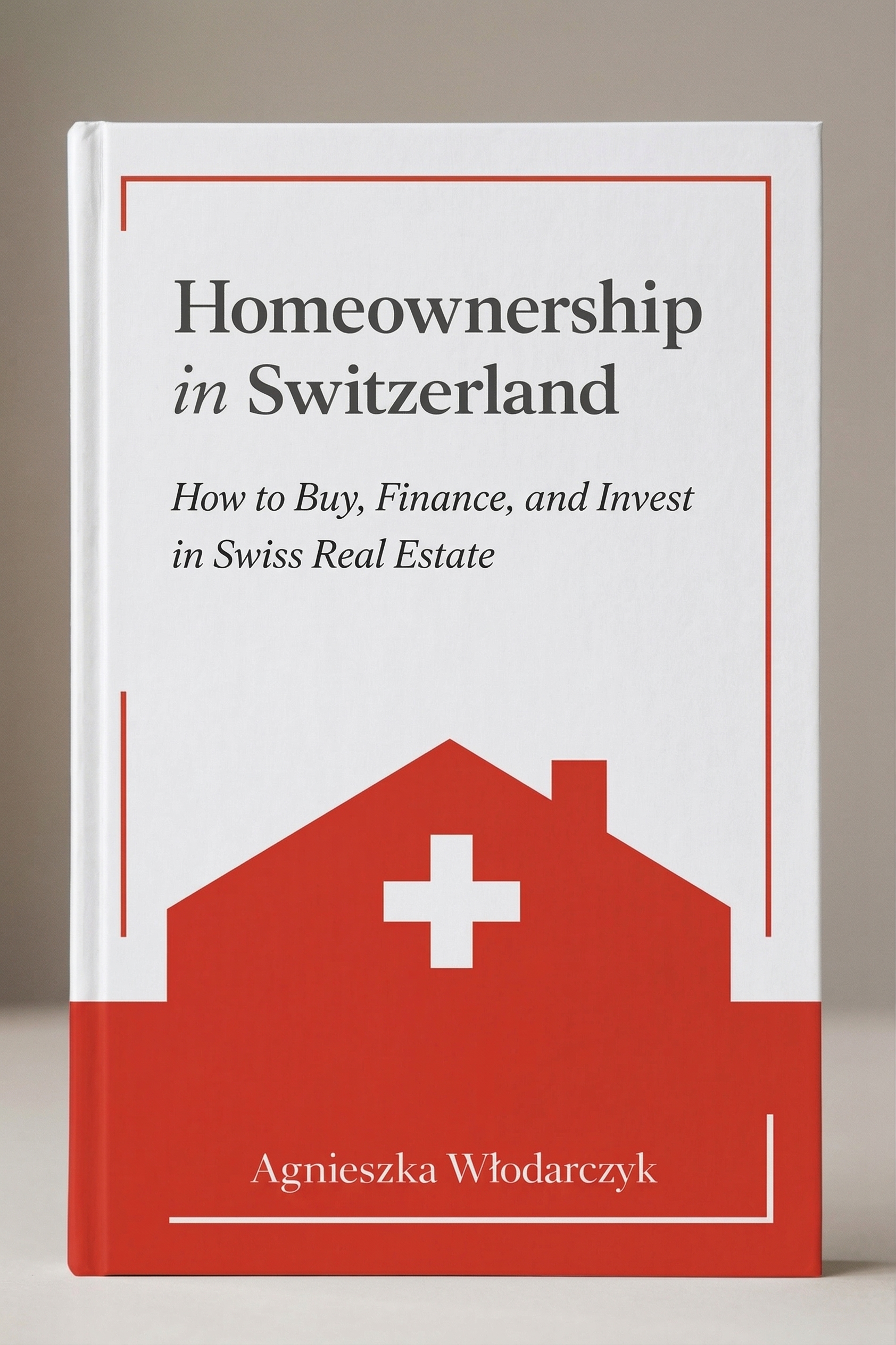
This article is part of a blog series on homeownership in Switzerland. Each post is a simplified, standalone piece drawn from my upcoming book Homeownership in Switzerland: How to Buy, Finance and Invest in Swiss Real Estate, which looks at the topic holistically.
Coming in 2026 Homeownership in Switzerland
I’m writing a book for people who want to understand the Swiss property system before making a million-franc decision
Frequently Asked Questions
How much did Swiss property prices fall in the 1990s?
The Swiss property crash of the 1990s was one of the largest real-estate corrections in modern Swiss history.
Nationally, apartment prices fell by roughly 25% between the early 1990s peak and the mid-to-late 1990s trough. Some regions experienced smaller declines, while others were hit harder. Apartment prices in Zurich fell 20%, while in Bern 16%.
If you want to understand why leverage can amplify both gains and losses during such periods, see my article: The Power of Leverage: How Homeowners Build Wealth Faster.
How long did Swiss property take to recover?
Recovery depended heavily on location.
In cities such as Zurich, property values generally did not return to their 1991 peak levels until 2005. Depending on exactly when you purchased, that could mean waiting 14 years before seeing your property value growing.
When evaluating property, I find it useful to think not only about losses but also about opportunity cost. Every year spent waiting to recover is a year when your capital could potentially have been compounding elsewhere.
I explore this concept in detail in ETF vs Swiss Property: The Opportunity Cost of Buying a Home.
What happens if mortgage rates rise sharply?
Higher mortgage rates affect homeowners in two ways.
First, they increase monthly housing costs when mortgages need to be renewed.
Second, fewer people buy when mortgage rates are high, which naturally puts downward pressure on prices.
This is one reason Swiss banks test affordability using much higher theoretical interest rates than current market rates. The system is designed to ensure that homeowners can survive periods of higher borrowing costs.
The relationship between interest rates and property prices is one of the most important drivers of the Swiss housing market. I discuss mortgage mechanics and affordability rules in more detail in Rent vs Buy in Switzerland: Which Is Better?
Join 1'400+ readers making smarter Swiss financial decisions:
Send me the next guide
Great content! Keep up the good work!