Take this calculator with you on iPhone
The exact same actuarial engine packaged into a fast, standalone app.
-
✓
Keep your baseline numbers saved.
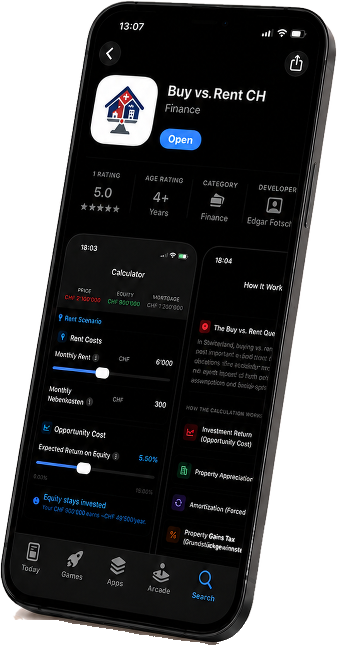
Buy vs. Rent Calculator — Switzerland
The buy-vs-rent, what makes the most financial sense.
Annual Cost Comparison
Wealth Projection (Net Worth)
Projected net worth after 1, 5, 10, 20, and 30 years. Includes property appreciation minus gains tax (if buying), investment returns on equity (if renting), purchase costs, rent inflation, and reinvested savings.
| Period | Buy Gross (CHF) | Gains Tax (CHF) | Buy Net (CHF) | Rent Net (CHF) | Advantage |
|---|
How this calculator works
When you buy a home, your down payment is tied up in the property. If you rented instead, you could invest that money (e.g., in the stock market). The return you miss out on by buying is a “cost” of owning — or equally, a “gain” of renting. We include this to make the comparison fair.
Owning a home offers a powerful advantage: leverage. Since you
likely
use a mortgage to buy, you earn appreciation on the total property value,
not just your down payment. This means your return on equity is magnified
essentially
by the bank’s money.
However, this leverage works both ways: if the property value falls, your loss on
equity is also magnified.
Property appreciation has historically run 4.7% annually in Zurich, 3% in Bern
and 5.1% in Geneva since 2000. Source: SNB
Allowances for paying back your mortgage aren’t a “cost” — they are savings that build your equity. That’s why we don’t count amortization as an expense in the annual cost comparison, but we do show it separately.
When you sell a property in Switzerland, the profit is taxed at the cantonal level.
The tax rate is degressive — the
longer you hold the property, the lower the rate.
Zurich example: ~60% (1y), ~50% (2y), ~32% (10y), ~20% (20y+). Default 20%
assumes ~20-year hold.
The tax can be deferred if you buy a replacement property in
Switzerland.
The wealth projection table shows the impact of this tax on your net worth at each
period.
Buying a property incurs one-time costs: notary fees, land register entry, and
transfer tax (Handänderungssteuer). These range from ~0.1% (Zurich) to ~0.5%
(Bern, Vaud) of the purchase price.
These are sunk costs that reduce the buyer’s starting net worth in the
wealth projection.
Whichever option is cheaper in a given year, the person on the cheaper side reinvests the difference at the equity return rate. This makes the comparison fair: both people have the same total budget, but the one spending less can invest the surplus.
Switzerland is expected to abolish the imputed rental value (Eigenmietwert) and
significantly restrict or remove mortgage interest deductions for most homeowners. A
temporary, limited deduction may apply for first-time buyers.
The exact start date is not yet confirmed, but current estimates point to around
2028.